Organizaciones y Cultura

Organizaciones y Cultura

lunes, 26 de abril de 2010

Africa


Africa could be named the forgotten continent of the world. It is sad that many times instead of reffering to a specific country like Mozambique, we always say Afica. African people this African people that, we generalize them as a whole and we don't see all the diverse cultures this country has. The generalization goes deep when we believe that all african countries are poor, have health problems, that they live in a jungle, that they live in tribes, live in continuos ethnical disputes, and that the only good thing they have is the safari's. It is prety much as how the world generalizes Colombian people as drug dealers, gorrillas and that we also live in a jungle. All this stereotypes should stop an more research must be done before we generalize a country or a continent.

Area: 30’131.536 Km².
Coasts: 40.142 kilómetros.
Population: 972 millions. which is 13.6% of the worlds total population.
Life expectancy: 47,9 (male) y 50 (female).
Economic growth: 4,3 %
There are more than 600 ethnic groups.

Africa has 53 independent states, whom all added up have only a 17% of arable land. Economically only South Africa, Liberia, Libia, Nigeria and Algeria are important or are distiguished. The last three countries have the biggest gas reserves in the continent.

Africa has a tight cultural relationship to the European invasion and authoritary distribution of land they suffered in 1885. This event took to Africa new cultures, languages, religions, beliefs, etc, that where impossed.

Western Management Style
Individuals care only for themselves
Managers have the power
Selection process
Experience
Isomorphic culture

African Management Style
Collectivist who protect and promote the interests of the group
Chief and elders have the power
Tend to favor their families and friends
Seniority
Multiethnic culture

1. What is Ubuntu? How was it applied to support the merging process of the two companies? (3 examples)

According to the case study Ubuntu is the philosophy that one finds one’s own humanity in helping others to find theirs.


It helps to understand the culture, values, beliefs and norms in Africa and it helps to give companies a competitive advantage.

They use to value communication as a machanism to solve problems, if you deal problems personally is a way of respect and that you care for them.

To make a clearer perspectiveabout ubuntu and what it means watch the following video of Nelson Mandela a freedom icon.


Bibliography:

Mangaliso, Mzamo. 2003. Building competitive advantage from Ubuntu. In Thomas, David Clinton, editor, Readings and cases in International Management: A cross-cultural perspective.

http://es.wikipedia.org/wiki/Ubuntu_(filosof%C3%ADa)

Video: http://www.youtube.com/watch?v=XgY4UvFWbs0

Picture:http://antenamisionera.files.wordpress.com/2009/10/africa0.jpg

martes, 20 de abril de 2010

South Asia

South Asia is comformed by Afghanistan, Pakistan, India, Maldives, Sri Lanka, Nepal, Bangladesh, and Bhutan.

This Region has more than 1.4 billion
people and it's said that is home for half of the world's entire poverty.


Hinduism, Islam and Buddhism are the dominant religions in this region.


This region has been distinguished by its achievements in the fields of education; industry; health care; information technology and services; international trade; business enterprises; and outsourcing services.


But the region has also faced some issues that has difficulted the total harmony and development of the region; religious extremism, high levels of corruption, disagreements on political boundaries, and inequitable distribution of wealth are just some examples. The most extreme case is faced by the territorial conflict faced by Pakistan and India.

India during the last decade has grown enourmosly, transforming itself into one of the most fast growing countries in the world. It is widely known for its outsourcing services and its market has been attractive for many investors. Indian government has planned for the year 2025 to be one of the world powers. Hindi and English are the most spoken languages in India and now days English is tought in middle school and high school as a program to standarize english as their second language and improve educational quality. This country is also considered like the mother of generic drugs due to the fact that they have had experienced high development in technology, science and manufacturing medicines.

The caste system is probably one of the cultural facts that distiguish Indu people, the caste shows in a certain way the social satus in the society, it is closed and has limits between the castes. Limitations in occupation and social participation. The marriages are arranged between castes and eventhough this seems crazy for us, this is a very important issue in India, they respect it, believe in it and they enjoy it.


•BRAHMANS: the priestly and learned class
•KSHATRIYAS: the warriors and rulers
•VAISYAS: farmers and merchants
•SUDRAS: peasants and laborers

The way to define in which caste people is depends on rituals and beliefs

watch the following video to make yourself and idea of India diverse culturality.


1. What do you think are the reasons behind the fast-growth outsourcing industry in India?
Reasons behind the fast-growth outsourcing industry in India:
According to the case “HR Challenges at Computer Age Management Services (P) Ltd.” The Management Case Study Journal 7 (2): 41-51

One of the reasons that made India's outsourcing so popular is the fact that they can speak english, the business language of the XXI century, and a language spoken in two major markets, United States and UK.

The laborforce is qualified and cheap, there are more than 1 billion people living in India, this defenitly reduces labor costs.

Another reason is that the people who work in the outsorcing industry are young teenayers between 20 and 30 years who are in college, who are abitious and want to earn money during their free time.

Finally India is playing a key role in the world board now days specially with the outsorcing of softwares.

Bibliography:

HR Challenges at Computer Age Management Services (P) Ltd.” The Management Case Study Journal 7 (2): 41-51

Video: http://www.youtube.com/watch?v=cDqDZleHjm8&feature=related

Photo:http://www.virtualcurriculum.com/N3225/spring2006/inderjit/south_asia_map.jpg

http://en.wikipedia.org/wiki/South_Asia

http://www.aseansec.org/

miércoles, 17 de marzo de 2010

East Asia


Picture Taken From http://www.gotterdammerung.org/graphics/map-east-asia.gif

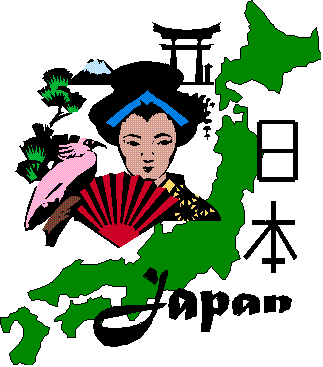
The eastern part of Asia has many cultural similarities between the countries that conform it due to the proximity they have and the historical invasions they had suffered. The countries that conform Eastren Asia are: China, both Koreas, Japan, Hong kong, Taiwan, Mancau, Mongolia. These countries represent more or less a 30 percent of the total Asian continent.
In this blog we are going to center our attention in only two countries which are Japan and South Korea.
After the reading we could see that Japan and Korea have many similarities in their managing styles due to the proximity and because during many years Japan occupied the territory of what we know today as korea. It is said that the Korean's model is basicly a copy of the Japanese model, but they have cultural managing differences. One of the similarities we could find between these two countries is the Chaebol structure, the Chaebol structure stands for a conglomerate of multinational business managed or manopolized by families in Korea. an example is Samsung. In Japan they have the zaibatsu model, that basicly stand for a conglomerate of industrial and financial businesses. Another similarity we could found is the way they negotiate, which in both sides are based in respect, are jealous protecting their people with sanitary norms and are critical thinkers before taking any decision, they won't give an inmediate answer. Now let's analyze some differences.


Korea:

* Use a hierarchical authoritarian structure where the important decisions are taken by the top managers.
* They are more individualistic
* Are traditionalist and are very attached to blood lines or family figures
* No job stability
* Tight relation between the government and the companies


Japan:


* Use a Horizontal structure where cooperation and interaction between employees is involved
* Long-term oriented who try to mantain good relationships
* Close related with the suppliers
* Try to create value on their products and maximize the profits
* Loyalty and trust are highly valued
* Tend to guide the organization based on corporate values


If you want to make a better idea of the similarities and differences between the managing styles I invite you to visit Carlos Torres blog on the following link :

http://oyc2010.blogspot.com/2010/03/east-asia-korean-and-japanese.html
He has a very interesting chart where he shows the main key points of the managing styles Korea and Japan have. By the way I recomend his blog as one of the most complete and interesting, you should take a look of it.


References:

Jangho Lee, Thomas W. Roehl, Soonkyoo Choe , What makes management style similar and distinct across borders? Growth, experience and culture in Korean and Japanese Firms.
http://www.usergioarboleda.edu.co/asia/negocios_japon.htm
http://en.wikipedia.org/wiki/Zaibatsu

Images taken from:

http://www.uni.edu/becker/japan1.gif
https://blogger.googleusercontent.com/img/b/R29vZ2xl/AVvXsEhy5x-dkBjQ6TI8kd2jb-t-rahQJB2uOtb9lG01T4rK2l0T-oXnfEC_EV9lMtGBdv1slSQvyKdXFEZYpaHWuhpy-iYYyGcuhd8VkqqRJnYBixGFjez08yMX4Gvw_WnOHZFeVc_hfOJU-nMf/s320/300px-Bandera_de_Corea_del_Sur_Explicada.png

China

As we know China used to be a closed country in terms of businesses due to the ideological thinking imposed by Mao Zedong, but in 1978 Deng Xiaoping traced a strong cultural reform which leaded China to a huge economic growth that has lsted to actual days. After this changes, China has been gaining territory in the global space thanks to the incursion of more than one billion people to the game. These people had a very powerful tool and it was the low costs of labor they offered, opportunity widely used by multinational companies due to the fact that many of them transferred their manufacturing plants to China in order to reduce costs, better known as offshoring.

After the inclusion of China to the WTO in 2001, many companies moved their plants to china, letting chinesse people gain experience and learn from the methods foreingn companies had. With this the economy began to grow, employment statistics rised considerably, etc. This is the girst thing China is doing, learning from others in the short term for later on in the long term use all the knowledge adquiered to become a superpower. A quite ambitious strategy that if it gives a good result, the world should prepare to confront a economical monster. In the long term China will pass from being a manufacturer country to a one thata can create, develop and design its own stuff, adding to it value and high standards of quality at a very low price.

To make a better idea of how businesses are working now days watch this video:


The chinesse people always want to know what your company can do that they can't , are very proactive, have great energy for businesses, are always willing to learn from others, their intecultural adaptability is rapidly improving due to the increasing demands of the global marketplace and they have a medium tolerance for change and risk. Cultural advantages that will defenitely help this country tu success and why not, become the first world power.


In order to answer the question of this blog, we have to understand what the Guanxi term stands for. The term Guanxi is related to the friendship or exchange of favors between two or more persosns. There are two types of Guanxies, The vertical Guanxie and the horizontal. The vertical Guanxie stands for the relationship between the managers and the employees, the second one stands for the relationships that can be formed in order to harmonize with the society. The guanxi philosophy is beeing implemented in chinesse culture as a way to mantain more stable relationships in business, inside of China and abroad, serching to increase the confidence in the investor. It is very important because it allows the chinesse people to mantain good relastionships with the clients for long-term periods and it also improves their world wide image as good business people. With the guanxi philosophy the chinesse people are demonstrating thata are very conservative to other people and they rather preferr to know who the person is before they do business, something thata I consider as an obstacle for China's attempt to be the first world power, but at the same time secures them against uncertainty.


References:


Chun Lisa Chen and Mark Easterby-Smith, Is Guanxi still working, while Chinese MNCs go global? The case of Taiwanese MNCs in the UK, 2008
The World Is Flat by Thomas Friedman chapter 3.

Images taken from:
http://www.regent.edu/acad/global/publications/rgbr/vol2iss1/images/2008_April_Guanxi.jpg http://columnacritica.files.wordpress.com/2009/10/china-flag.jpg

Video taken from:
http://www.youtube.com/watch?v=brs777fdA2A&feature=related

lunes, 15 de marzo de 2010

Managing Diversity


For multinational and non multinational companies, managing diversity has become one of the key points in order to have agood environment in the company, manage good relationship with clients and suppliers, helps as a support to the internationalization process and helps the company in acieving a maximization.
Some examples of diversity are: the religion, sexual orientation, costumes, social-economic status, etc. the important thing is that employees should be managed and treated as equal and avoid descrimination or maltreatment in order to motivate and commit them. but understanding and managing diversity could also help a company to defene and understand its maket orientation, which will be translated in better profits beacause you are attacking the right point.
watch this video to make an idea of how diversity can affect, positively or negative a company.


Companies must also be cautious with the way manage diversity because if the media or the community gets to know a case of discrimination or mistreatment in the company, a bad reputation of it could affect it not only with sales, but also in the image, further businesses, profits, etc.

QUESTION: do you think the IBM case reflects a strong organizational commitment to diversity?, why?

After analyzing the IBM case i believe or support that there is an strong organizational commitment from IMB and that they are interested for diversity inside the organization. I base my statement in the example of the number of executives hired by the company that had or have dissabilities. i also base my statement because IBM want's to know the employee problems inside and outside the company, crete a dialogue, face each problem, and finally try to solve it. Always looking for a better synergy between the teams in the organization.Involving every one is the main goal IBM has, and from my point of view is a great strategy because it will translate into better profits and a better work environment and shows a long-term relationship.

References:
Stanley F. Slater, Robert A. Weigand b, Thomas J. Zwirlein, 2008, The business case for commitment to diversity (Page 201 – 209)

Class presentation
Image taken from:

http://www.mscco.net/images/Coachi1.gif

Video taken from:
http://www.youtube.com/v/H8nKQyTQe_U&hl=en_US&fs=1&

domingo, 14 de marzo de 2010

Migrant Workers


As we saw in class, migrant workers are the ones that go from one place to another to work due to voluntary or involuntary reasons. A clear example of migrant workers is the British Empire, during the colonization age, the British people migrated to the empire's colonies searching for wealth and better opportunities. Now days the most wanted places to migrate are : The United States of America, Spain, Italy, Canada, New Zealand, Germany, Russia, and others, due to the good opportunities these countries offer and because they are developed countries.
The reasons to people migrate are due to many factors like, violence, work opportunities, improve life quality, higher income, political reasons, stability, etc. All these reasons could be summarized into two categories, the voluntary or involuntary reasons. The voluntary reasons are when the people goes abroad in order to look for better opportunities. by the other hand the involuntary reasons are when the people are forced to leave the country due to political problems, such as war or political instability, economical problems, etc. This usually happens on low income countries and its people look to the developed countries as a way of solving their problems. An example of this is the American dream many people have. But it is the other case where well educated and skilled people migrate in order to improve their income and knowledge, this must not be confused with expatriate assignments or overseas experience, now that the main difference with them is the social economical factors. people who move from their domestic land to another looking for better wages, or who move to earn more money are called immigrants.
All the migrant process is related to the push and pull factors, or the attractiveness or repellents of a country to invite people or to make people leave from a country.
If we analyze the case of Canada, we could see that this country has been highlighted as a discriminante country because they used to accept only immigrants from the UK and USA. Later on the Canadian government was focused on looking for high skilled people and educated in order to compete and fulfill the high standards the world was demanding. By the other hand the country had to prevent the migration of native people to other countries because the knowledge was leaving to other countries. Finally they had to face an aging problem, the country was managed by old people and they needed new ideas, teenagers. All these problems to be solved were a hard work to the government and they had a tough time with this. Time has showed that the quality of the poeple arriving to the country wasn't the best, reason why they had to implement the point system as a way of protecting their sovereignty and their interests. I don't consider this to be a discrimination process, I look at it a good strategy to improve, if you want to be succesful to the constant changes and challenges globalization is bringing with it, the ones that are the best qualified, and posses the best people will have a better opportunity to success. They are defending their own interests, wealth and sovereignty,I dont see anything wrong with it and I argue that migration should be regulated.
References:
class presentation


Images taken from:
http://newsimg.bbc.co.uk/media/images/44073000/gif/_44073837_world_emig_uk_416map.gif http://api.ning.com/files/Vu7ZrXOf0c22UdUiVuFGvvGWxZ5OjpkUd*d2CuBoHuiLZbuDZ4jAaOQHqfzcbZSOdBvmmsURe3USfdhy8QVW5dMx0usfvhiC/American_Dream.jpg

jueves, 11 de marzo de 2010

Expatriates Assignments And Overseas Experience


Expatriate assignments is defined as the type of people who go to another country, hired in most cases by transnational companies, in order to work successfully in a international environment. After a period of working outside of its domestic environment, the individual might return home working with the same transnational company and share all his acquired knowledge and skills in order to improve the company at the domestic market. This phenomenon has been powered during the last years by the globalization the world has experienced during the XX century. Although, thanks to technology and internet, the number of expatriates in the world tends to reduce.


The key objective of expatriate placements is to encourage professional development. It is also used for knowledge transfer and in particular for long-term knowledge transfer, for example when it is necessary to transfer culture, values, and particular technical experiences in specific competence areas.


Expatriate assignments is not the same as Overseas experience. An oversea experience is when a individual decides to go abroad, in this case the individual isn't sent by a company. Usually the indivudual has saved money, have quitted his job, and had settled itself overseas alone. People under overseas experience usually leave and look for different kind of jobs and areas. Sometimes they look for not qualified jobs, like temporary jobs, in order to pay their needs. During their vacation they use to spend time traveling. After months or years of doing this they return to their home in order to resume their carreer.

One of the most critical processes for an expatriate assignment is the selection of the person who is going abroad. Choosing the wrong person to be an expat could make the assignment fail and will have a huge impact in the company's costs. in order to prevent mistakes in the selection process, the company must ensure a classified and punctual selection criteria. They have to look for a person that is flexible to changes or adaptable and they have to look for a person who has the capabilities learn and adjust to the environment quickly. It would be better if they hire people with traveling experience.


References:

http://www.aperianglobal.com/ped/velWino3_global1.pdf

http://search.ebscohost.com/login.aspxdirect=true&db=buh&AN=434394&loginpage=Login.asp&lang=es&site=ehos-live
http://www.associatedcontent.com/article/60305/expatriate_assignments_pay_big_bucks_pg2.html?cat=3

ImagestakenFrom:

http://www.expatriateadviser.com/images/iStock_000000394657XSmall.jpg
https://blogger.googleusercontent.com/img/b/R29vZ2xl/AVvXsEh7GgQw1l724Z9VXX5_U9XpcFABT4ICTS9wn6mXVkIvDETVEhhuDNMsdfUvulXwpy375B3g5yC4ZPWcQprhHldf49-M08hoFkC4Qv5CyUiahG4LJXot-HEhlRat9XqvCN425HTuxH-gJ4bF/s400/www.jpg

Video Taken from:

http://www.youtube.com/watch?v=d1hL6XKyaTY